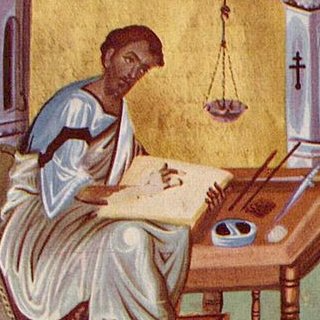
The following timeline shows how Marcion’s canon (Evangelion + Apostolikon) was appropriated, expanded, and re-branded as the Gospel of Luke and the Letters of Paul.
140s
- Marcion wrote a gospel (Evangelion) sometime in the 140s, using Matthew’s oracles as a sayings source, and likely also using Mark as a narrative source.
- Marcion wrote a series of open letters (Apostolikon) in the 140s under the moniker ‘the apostle’, each opening with, “Grace to you and peace from God the Father and the Lord Jesus.” There was no mention anywhere in any of the letters of anyone named Paul.
150s
- In the 150s Justin wrote over a hundred pages of text, mentioning all the main figures in church history, as well as those he saw as heretics. He mentioned Jesus, James, John, Peter, Marcion, Valentinus, Simon Magus, and many others—even Simon’s wife Helena. But he never once mentioned Paul or showed any awareness at all of Paul’s existence—not even in connection with Marcion.
- Paul is also never mentioned by name in any of the Clementine Homilies or anywhere in the Recognitions of Clement or the associated correspondences with James.
160s
- Sometime in the 160s, Marcion’s letters were expanded and attributed to a newly invented character—Paul. “I, Paul” was inserted dozens of times throughout, none of which were in Marcion’s letters.
- Four personal letters were also composed in Paul’s name that were not attested to in any form in Marcion’s canon: 1 Timothy, 2 Timothy, Titus, and Philemon.
170s
- In the 170s a gospel was written and addressed to Theophilus, the presiding archbishop in Antioch. The author used Marcion’s gospel as their primary source, in addition to a handful of other sources that we still have today: Infancy gospels of James and Thomas, Acts of Pilate, Matthew, etc.
- Also in the 170s Acts of the Apostles was composed for this same Theophilus. In it a narrative was invented for the character Paul that aimed to establish him as a major figure in church history, especially in Antioch. Of the 18 times Antioch is mentioned in the Bible, 16 are in Acts.
- Acts of the Apostles borrowed a narrative from the opening book of the Recognitions of Clement (aka the Ascents of James) and named Paul as the previously unnamed adversary. Where the Ascents narrative concluded, Acts inserted Paul’s conversion episode.
- Between Acts and the “Pauline” corpus, the name “Paul” is used 157 times. The name is only mentioned 1 time elsewhere in the Bible, at the end of 2 Peter. This ending to 2 Peter is a clear late second century composition.
180s
- In the 180s, Irenaeus wrote Against Heresies. In it he claimed “Luke” was the author of the gospel to Theophilus, and of Acts, and that “Luke” was a first century travel companion of “Paul.” He called Marcion a heretic and accused him of “mutilating Luke’s gospel.”
190s
- Sometime in the 190s or early 200s Tertullian wrote Against Marcion. In it he cited all the differences between Marcion’s gospel and that of “Luke,” as well as all the differences between Marcion’s letters and those of “Paul.” He argued for the priority of Luke and Paul, but all the internal literary evidence, as well as the externally attested evidence, suggests the opposite.
200s & 300s
- The arguments of Irenaeus and Tertullian won out and became the accepted narrative of the church.
 Choose Love
Leave a comment